Oct 19, 2026
Think about the last bite of food you truly loved. Maybe it was a ripe mango, a square of dark chocolate, or a bowl of soup on a cold day. Now think about something you couldn’t stand: a bitter pill, spoiled milk, that one vegetable you’ve avoided since childhood.
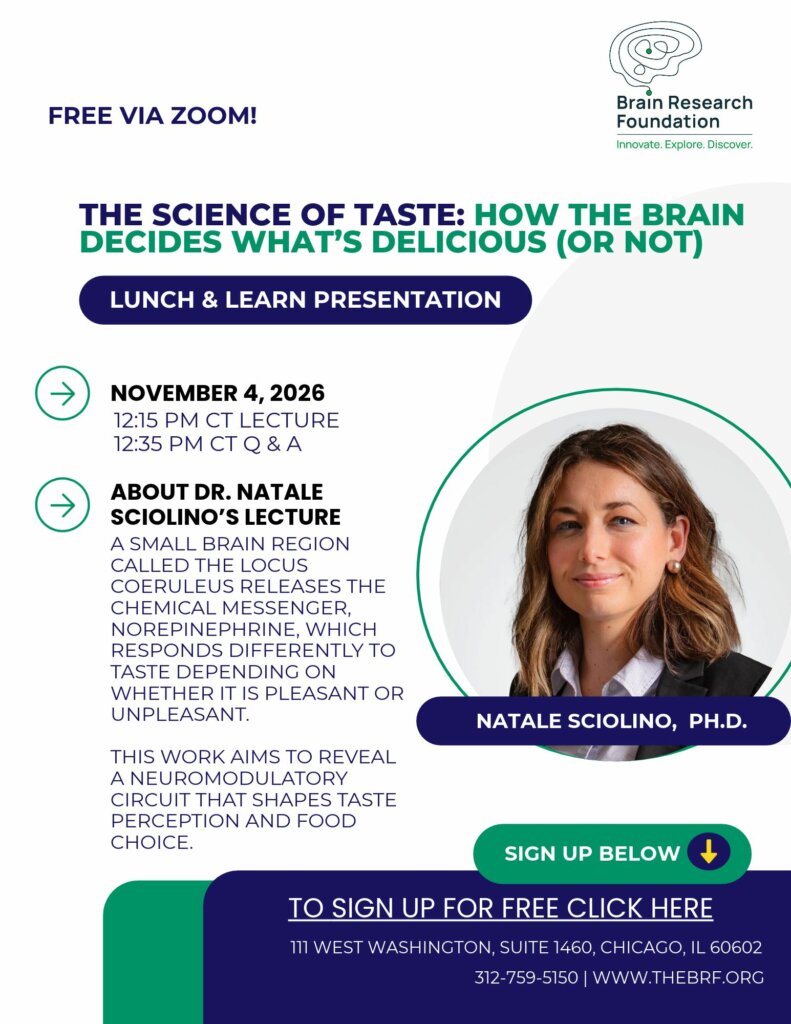
We tend to credit (or blame) our tongues for these reactions. But the tongue only collects the signal. The real verdict on whether something is delicious or disgusting is handed down by the brain. On November 4, 2026, the Brain Research Foundation invites you to a free Lunch & Learn on Zoom with neuroscientist Natale Sciolino, Ph.D., who studies exactly how that verdict gets made.
A tiny brain region with a big say
Deep in the brainstem sits a small cluster of cells called the locus coeruleus. Its name means “blue spot,” a nod to its faint bluish color. Small as it is, it sends connections throughout much of the brain.
The locus coeruleus releases a chemical messenger called norepinephrine. You may know norepinephrine for its role in alertness and attention, the “pay attention, this matters” signal. Dr. Sciolino’s research shows it also has something to say about food: norepinephrine responds differently to taste depending on whether that taste is pleasant or unpleasant.
In other words, your brain doesn’t just register what you tasted. It flags how it felt, and that flag shapes what happens next.
Why it matters: from taste to food choice
The goal of this work is to reveal a neuromodulatory circuit, a brain pathway that fine-tunes how other brain areas respond, which shapes both taste perception and food choice.
That matters well beyond the dinner table. Understanding how the brain decides what’s appealing could help explain why our food preferences form the way they do, and why they can be so hard to change. It’s the kind of basic science that lays the groundwork for future insights into eating behavior and health.
Hear it from the scientist
In The Science of Taste: How the Brain Decides What’s Delicious (or Not), Dr. Natale Sciolino will walk through how the locus coeruleus and norepinephrine help the brain sort the pleasant from the unpleasant, and what that tells us about why we eat what we eat.
The talk is part of the Brain Research Foundation’s Lunch & Learn series: a short, accessible lecture you can join from your desk or kitchen table, followed by a live Q&A where you can put your own questions to Dr. Sciolino. No science background needed, just curiosity (and maybe a snack).
Event details
| Date | Wednesday, November 4, 2026 |
| Lecture | 12:15 PM CT |
| Q&A | 12:35 PM CT |
| Where | Online via Zoom |
| Cost | Free |
| Host | Brain Research Foundation, 111 West Washington, Suite 1460, Chicago, IL 60602 · 312-759-5150 · thebrf.org |
Spots are free, but you’ll need to register to get the Zoom link.