
Subscribe to Our Newsletter
Be a part of the impact. Stay up-to-date with BRF news, including new programs, upcoming events, and updates on our brain research journey.
Why is Neurological Research Important in Everyday Life The brain controls everything we do and think. It is the central engine of the body, the driving force. Yet, we are only starting to understand how it operates. While neurological research may not be as exhilarating as pioneering smartphone technology, it is essential to the quest for knowledge and treating diseases such as Alzheimer’s, Parkinson’s, or multiple sclerosis (MS), amongst others. Brain research (or neurological research as it is commonly referred to) is a general term for medical, scientific, and technological studies that improve our comprehension of how and why our brains function. These studies incorporate neurological disorders like Alzheimer’s disease, autism spectrum disorder, or Multiple Sclerosis; psychiatric disorders like anxiety or depression; sensory issues like hearing loss or (removed color) blindness; neurodegenerative conditions like Parkinson’s disease or Huntington’s disease; and traumatic brain injuries. At BRF, we fund a broad spectrum of brain research programs through our Seed Grants and our annual Scientific Innovations Award. Funding is used to make extraordinary discoveries about the brain, from how it functions to the links between lifestyle and disorders and essential findings about medical treatment and how the brain responds to it. We thus rely on generous and charitable people to make donations so that we can continue to fund our researchers and the projects on which they so diligently work. You may ask how you can get involved with funding Neuroscience Research. There are several ways to support BRF in our work and continue funding essential research programs that will aid medical and academic practice in the future. Whether donating on our website or attending one of our events, you can be assured that the money raised by BRF goes directly to studies executed by researchers and institutes working on the most up-to-date neurological advances.
Down syndrome is the most common genetic cause of intellectual disability in the world. Yet for decades, the question of why (why do neurons connect differently, why does cognition develop along a distinct path, and why does Alzheimer’s disease appear so frequently in people with Down...

Fragile X Syndrome (FXS) is one of the most significant genetic contributors to intellectual disability and autism spectrum disorder in the world — yet it remains widely misunderstood, underfunded, and under-researched. For the families living with this diagnosis, the research gaps are not ...
Therapeutic touch — the deliberate use of physical contact to support health and wellbeing — is not a wellness trend. It is a biological mechanism, deeply embedded in the architecture of the human brain. When skin meets skin, a cascade of neurological events unfolds: stress hormones d...
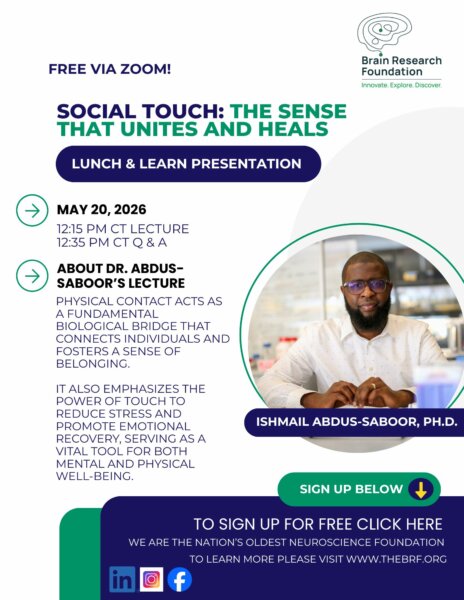
May 20, 2026 | Free via Zoom Join the Brain Research Foundation — the nation’s oldest neuroscience foundation — for our next Lunch & Learn webinar, featuring neuroscientist Ishmail Abdus-Saboor, Ph.D. In this thought-provoking session, Dr. Abdus-Saboor will explore the remar...

For decades, the prevailing medical model viewed mental health through the lens of deficit-identifying what was “broken” within the neural circuitry of the brain. However, through the lens of the Brain Research Foundation (BRF), a more sophisticated narrative has emerged. It is a narr...
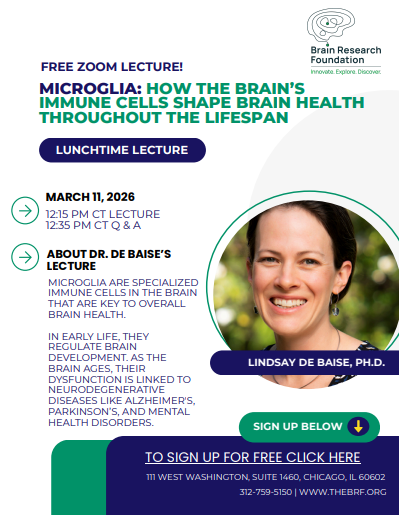
March 11, 2026, the Brain Research Foundation hosted one of its most anticipated lunchtime lectures of the year. Dr. Lindsay DeBaise, Ph.D., joined us over Zoom to explore a topic that sits at the heart of modern neuroscience: the role of microglia the brain’s own immune cells in shaping br...

The global opioid addiction crisis has remained one of the most urgent public health issues in 2025, and now that we are going into the new year, it requires attention now more than ever. For decades, the primary tool for severe opioid treatment has been the opioid itself, creating a devastating ...

What Are the Neurological Symptoms of a Concussion? Executive summary: A concussion is a mild traumatic brain injury that disrupts normal brain function, often due to a blow or sudden jolt to the head. Neurological symptoms of concussion can include headaches, dizziness, confusion, memory lapses,...
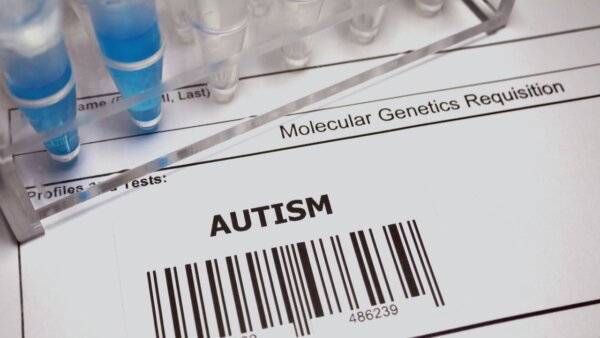
Summary: Many families and individuals ask whether there is a cure for Autism Spectrum Disorder (ASD). While science has made important progress in understanding how ASD affects the brain, no single biological marker or definitive cause has been identified, making a cure challenging. Instead, res...

This is for informational purposes only. For medical advice or diagnosis, consult a professional. The mirror can be a deceptive tool, especially for someone grappling with Anorexia Nervosa. What starts as a desire for control or an attempt to achieve an idealized body shape can quickly spiral int...
Be a part of the impact. Stay up-to-date with BRF news, including new programs, upcoming events, and updates on our brain research journey.